
Saturday in the Sierra
I have plenty of history under my belt.
Which means, simply, that I’m old.
And the older I get, the more I enjoy seeing and learning about things that are even older than I am.
Maybe it makes me feel younger — I don’t know.
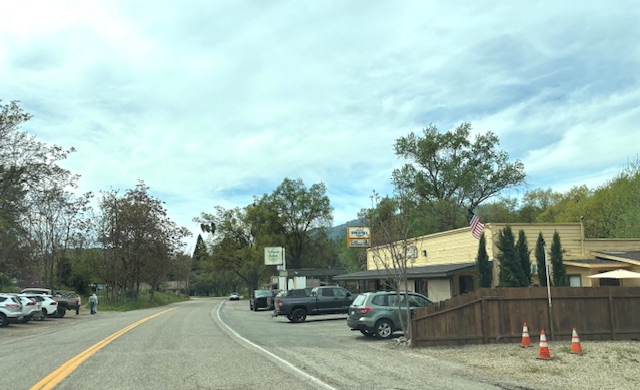
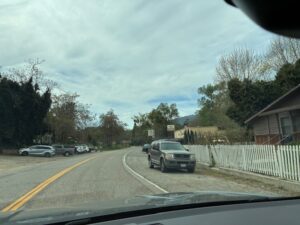 But whatever the reason — this past Saturday saw me on the road to the Sierra again — this time to the tiny eastern Fresno County community of Tollhouse.
Tollhouse is at an elevation of nearly 2,000 feet in the Sierra foothills. About 2,000 people live there.
The town is at the bottom of the famous/infamous Tollhouse Grade.
More on the Grade, below.
My destination this Saturday was the Eastern Fresno County Historical Society’s museum in Tollhouse.
And it was simply a delight to join the North Fork History Group for a tour there, admiring what Tollhouse volunteers who have put the museum together over the past quarter-century have done.
Want to know about the mining and logging and ranching that brought people to the area in the 1860’s? It’s there.
 Did you ever want to learn about the Native Americans who had settled in the foothill area thousands of years before the white man came? Yep. It’s there.
How about the mighty hydroelectric developments that became the envy of the world in the late-19th and early- 20th century — and created thousands of jobs along the way?
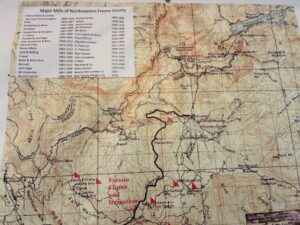
Or the numerous sawmills in the area, created from the mid-19th century on? You’ll find fascinating map after map and photo after photo of all of it.
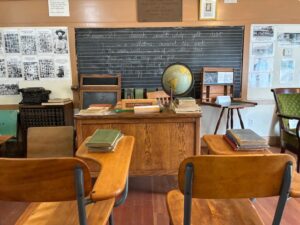 Most of those maps and photos are in what’s called the Bud Olson School of History.
That was, at one time, a schoolroom at the Auberry Elementary School. Museum founders moved it here in 1999, and it’s stuffed to the gills with truly interesting photos and maps that you’ve likely never seen — along with that schoolroom that kids used for decades.
Another building on the museum campus used to be the Burrough Valley Store and Post Office. Burrough Valley is about six miles from Tollhouse.
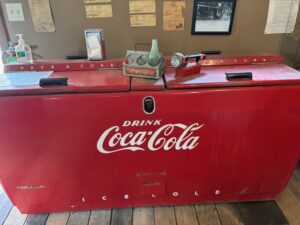 This little store is a delight to behold, and not just because it has one of those historic red Coca Cola units where you deposited your 25 cents and pulled out a heavy, frosted bottle of Coke.
Everybody my age or older got a Coke from a machine like that.
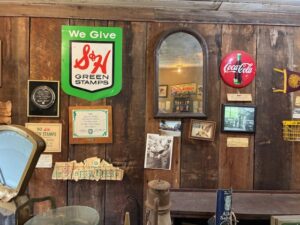 But wait, there’s more. Vintage signs that will make you feel young again, hanging on the walls. Remember S & H Green Stamps? Schlitz Beer (the beer that made Milwaukee famous)? Burgermeister?
Walk into that building, and you’ll want to stay for more than a bit.
Behind the store is a re-created blacksmith shop and an original saddle shed.
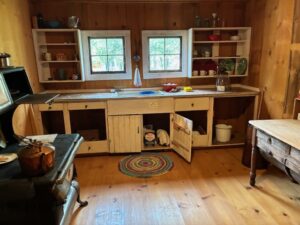 And then there’s the new “old” house that was built on the museum site a few years back. It’s an 800-square-foot structure designed to mimic what houses would have looked like in the Auberry-Tollhouse area more than 100 years ago.
There are no halls inside. The main living room leads right to the kitchen and has doors leading to the two bedrooms.
And — like homes built that long ago — this one has no indoor toilet facilities.
It’s a great look at life way back when.
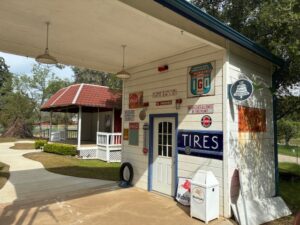 Then there’s the old-time gas station — at least, a station built to look like an old-time gas station. Yes, I remembered the station signage from my youthful days, and so will you.
And there’s a museum offering that is unlike any other I’ve seen around these parts.
The museum is built adjacent to Sierra High School. Before I left home for Tollhouse this past Saturday morning, Sharon told me that when she was a student at Washington Union High in Easton, her school’s athletic teams often played those at Sierra High.
And Sharon said she had learned that some of the students at Sierra High stayed in dormitories on campus during the week.
She was correct.
There were two dorms — one for males and one for females. The dorms were made available to students who lived up in the mountain areas miles from the high school.
During the winter, it would have been impossible to bus them down to the high school and back home every day — especially when snow blocked the roads.
The dorms were provided free of charge to the students and their families.
The museum now rents the former female dorm so visitors can see what on-campus student life was like.
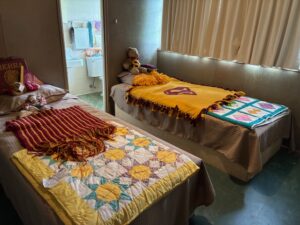 One dorm room has been kept intact (left). It could house two students. The rest of the dorm building has been altered, but there are many pictures of students who came through Sierra High during the years.
The dorms were used until the 1970’s, when mountain roads had improved dramatically.
Bottom line on this museum: It’s a true winner, and the folks who created it are justifiably proud of what they’ve built.
It will re-open for the year on Saturday, April 4, from 10 a.m. to 2 p.m. and be open every Saturday through December.
Admission is free.
After our tour, the History Group had lunch at the delightful Tollhouse Market and Grill, a few miles away. It’s a combination convenience store, gas station and restaurant.
And trust me, the food is good. Most of us had the standard burger with fries and drink. It was better than you’ll find at many of the “big guy” burger chains.
After lunch, I had a decision to make.
You see, the community of Tollhouse is at the bottom of the Grade that I mentioned above. The Tollhouse Grade.
That Grade was built in the mid-1860’s and was named for the tollhouse at the bottom that collected fees from the road’s users until 1878.
And it became famous — and infamous — over the decades because it was, and is, a narrow, steep (emphasis on steep) mountain route with switchbacks and hairpin turns that have turned many drivers from the Valley into white-knuckled wrecks.
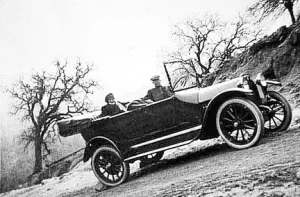 The grade was — and is — so steep that passengers often had to get out of their cars in the early days to lighten the load on the engine.
How steep was it — and is it? Cars in the 1950’s and ’60’s frequently got vapor lock on the way up the Grade, forcing the vehicles to sit on the side of the road until things could be fixed.
How steep was it — and is it? Neighbors across street from my boyhood home in Fresno once tried to haul their big boat up the Grade with their big station wagon.
The station wagon’s engine caught fire on the steep grade and burned up. It was a great story around our ‘hood for years.
Dad — who was, for a time, Mr. He-Man — always took the Tollhouse Grade up to Shaver Lake, disdaining the less-severe Auberry Road because it took longer to get to Shaver. I remember being in our car many times when Dad made that drive.
I was terrified.
But when I was old enough to get my driver’s license, I knew that one of the roads I had to take was, yes, the Tollhouse Grade.
I had to prove I could do it.
And I did.
The Grade was bypassed decades ago by the “Four Lanes,” a much wider, straighter and easier climb. And when the “Four Lanes” opened, I admit, I used it — along with most everyone else who wanted to go up to Shaver or Huntington lakes.
So much for “proving” anything.
Well, the decision I had to make when I left the Tollhouse Market this past Saturday was whether to turn left, toward the Grade, or right, toward Fresno.
Yes, the question ran through my mind — it actually did — could I still “make the Grade” after all these years?
Well, I turned left and got about a mile up Tollhouse Road, onto the Grade. But the road was getting narrower and steeper — and I was getting more and more nervous.
So — being the “Flatlander” I am — I found a dirt spot on the side of the road and turned around.
Maybe next time I go to Shaver Lake — and I hope it will be soon — I’ll have courage to drive all the way up the Grade.
Or perhaps I’ll just stop at the Tollhouse Market for another burger and call it a day.