History in the Foothills
It was another gorgeous October day here in the Valley this past Monday. You know the type — clear days and nights, highs in the 70’s and lows in the 50’s.
Just the type of day that prompts you to get up and go out. So I did — got up and went out, that is — driving up Highway 41 into the foothills of the Sierra in eastern Madera County.
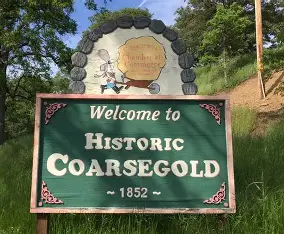 My destination — along with other members of the North Fork History Group — was a charming historical museum just south of the community of Coarsegold.
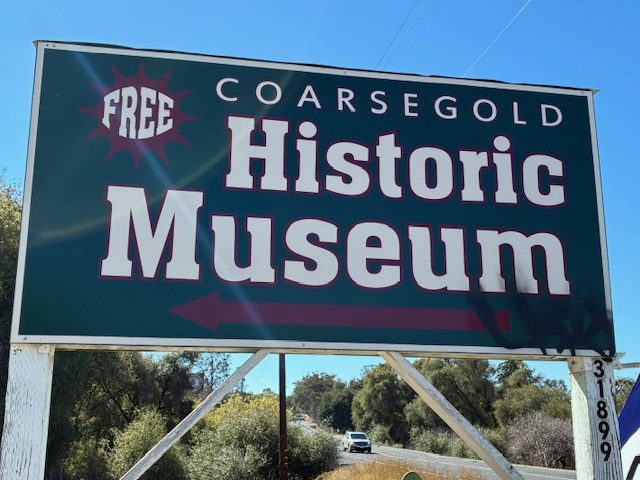
It’s easy to miss it if you’re heading up the 41 because the giant Chukchansi Casino dominates the landscape just ahead of the museum.
But it’s worth looking for the museum’s entry road. You’ll find several delightful buildings on the museum’s three acres, and inside those buildings are artifacts and photos detailing life and times in the area surrounding the old mining town of Coarsegold.
Looking at Coarsegold now — with its 4,000 or so residents — it might be hard to envision that it had a population of 10,000 back in the 1850’s. That’s when gold dust made folks in the area rich, but gold wasn’t the only treasure in those parts. Coal and quartz were also mined.
The town thrived in those years, and in 1880, the Yosemite Stage Road was built, connecting Madera to Yosemite through Coarsegold.
The Chukchansi native Americans are indigenous to the area, having lived there for 8,000 years or so. But once gold was discovered, things changed — and not for the better — for the Chukchansi people. Their land was stolen, disease spread through their ranks, and some natives were murdered. It was estimated that more than 90 percent of the native Americans in the area disappeared between 1848 and 1900.
But there has been a resurgence of Chukchansis — and the Coarsegold Historic Museum houses many artifacts of that culture.
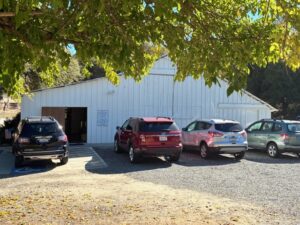 The museum is relatively young — having been created by the dogged efforts of the Coarsegold Historical Society in the early 1990’s. Volunteer docents maintain the buildings and grounds — and our tour on Monday showed how much they’ve accomplished.
The main display rooms are housed in the Barn, which was built by a previous landowner who used lumber that had come down the flume that existed then to carry cut timber from above Oakhurst to Madera.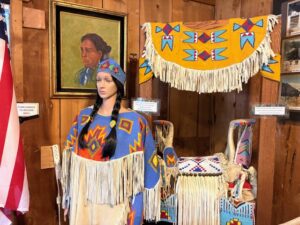
Inside the Barn are many relics from the past — from Native American outfits to photos of old-time Coarsegold residents and even, among other things, a really old-time Coca Cola dispenser.
You get a fine look at how Coarsegold changed over the decades.
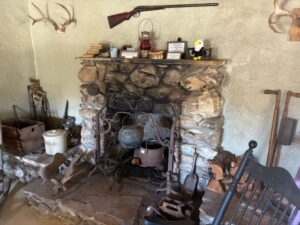 You could easily spend an hour in the Barn, but leave enough time on your tour to go into the Old Adobe — a structure that was built about 130 years ago as a way station on the rough road from the Valley. The original part of the Old Adobe (it’s been added on to) is a small single room with a giant fireplace, bed and table, and not much else.
Yes, people lived in this small room — built around 1897 on this very spot– and when you’re inside, you are sure to wonder how they did it.
Then there’s the Picayune School building, which was used by Native American children from 1913 to 1956. The building was moved onto the museum grounds in 1994, and it now provides more than just a look at what life was like in a one-room schoolhouse.
Children in the surrounding area make field trips to the schoolhouse each year. They get to play old-time games similar to what kids a century ago played.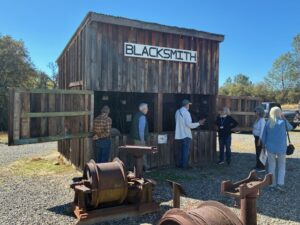
The museum grounds also have a small blacksmith shop, which volunteers built in 2012 with 100-year-old cedar planks salvaged from a barn on a Coarsegold ranch.
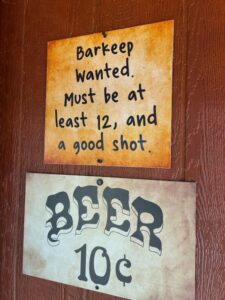 There’s also a “new” old-time saloon on the museum grounds. It was built in 2022 to look like a saloon would have looked 100 years ago. It was constructed because records indicate a saloon was on this property long ago, and the historical society decided to recreate it.
After visiting all the buildings on the grounds, you may be ready to call it a day and move on. But be sure to stop by the Native American village next to the Old Adobe, as we did. It was built in 2010 and is typical of villages inhabited by Chukchansi and Yokut tribes.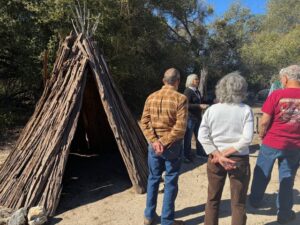
If you’ve brought your lunch, you can enjoy it in a shaded meadow area near the Barn. If not — and if you’re headed to Yosemite — you’ll find plenty of restaurants a few miles up the 41, in Oakhurst.
From there, it’s a relatively short jaunt to the national park.
So in the course of just one day along the 41 — albeit a long one — you could stop at the museum and learn a bit of local history — enjoy lunch a few miles up the highway — and then drive into Yosemite.
Admission to the museum is free — but call ahead to make sure it’s open.
All in all, not a bad deal. Not bad at all.